
Welcome
SilverWinds Publishing is a boutique publishing company of Flute Music by American composers and arrangers.
Please contact Francine Pancost about specialty parts - Double Contra, F Bass, F Contra etc.
francine@rossflutestudio.com
New Compositions
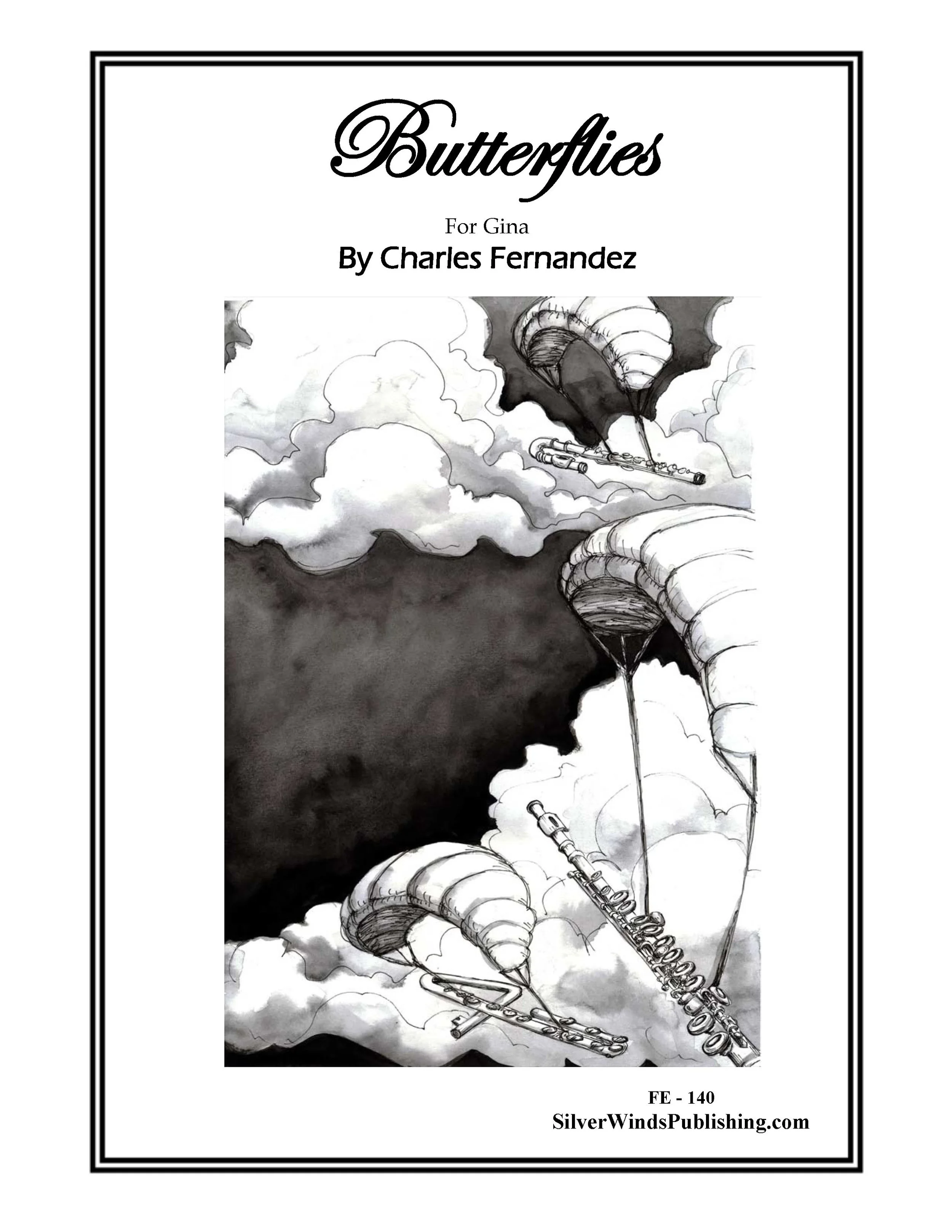
BUTTERFLIES by Charles Fernandez
Butterflies: Genus for GINA, was written for a dear friend and beloved member of Song of the Angels Flute Orchestra who passed away from Cancer a few years ago. I used her love of butterflies as a guide to this work’s composition.
INSTRUMENTATION Varies by Movement:
** Movement II. has 3 piccolos and only 2 C flute parts. Movement III. Has 3 C flute parts.
SilverWinds has added parts to the most possible arrangement but I will also add the parts separately for the director to decide who plays which parts.
Piccolo (3 players)
Flute I
Flute II
Flute III
Flute IV
Alto Flutes I
Alto Flute II
Bass Flute I
Bass Flute II
Contrabass Flute
Double Contra in F
Double Contra I
Double Contra II
TIMINGS
I. Monarch Migration - 3’ 22”
II. Western Blue Pygmy (Smallest) - 2’23”
III. Blue Morpho (Most Beautiful) - 3’15”
IV. Goliath (Largest) - 4’47”
V. Skipper (Fastest) – 3’10”
This is a digital version of the piece that you can download as a PDF and print.
Personal Sun Music/ASCAP
Distributed by SilverWinds Publishing
INSTRUMENTATION
Solo Alto Flute
4 C Flutes
Alto Flute
2 Bass Flutes
Contrabass Flute
PROGRAM NOTE
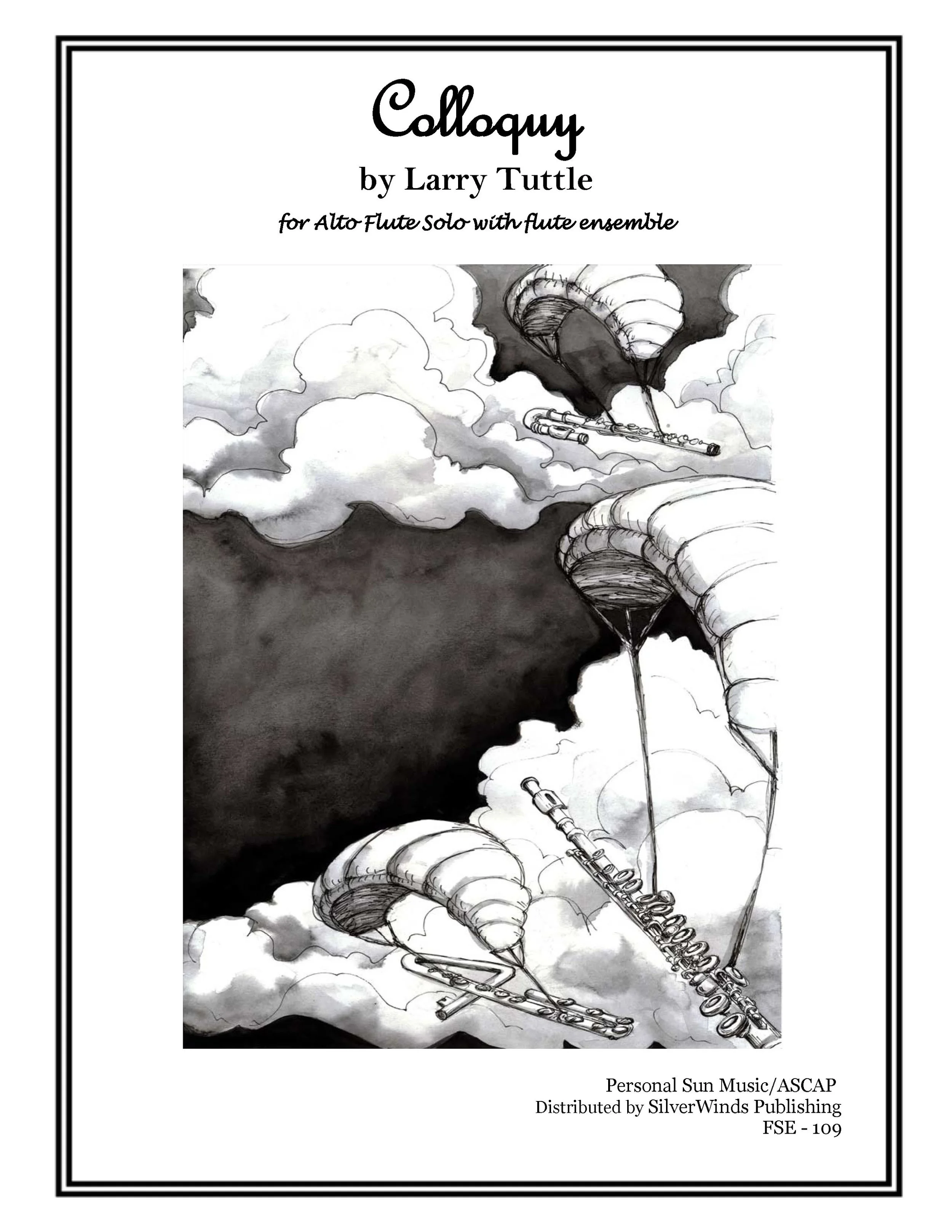
A Colloquy is a conversation, and this piece is just that - a conversation between a soloist (alto flute) and a group (flute choir).
The piece was written on a commission from Lisa Norton, the principal alto flute player in Flutesonic, a Los Angeles area flute orchestra. My main goal right from the start was to show off the sheer beauty of sound that can be produced from the instrument, especially in those warm lower ranges. In order to do this, I had to work hard to keep the group from covering up the soloist. The format that I came up with has a lot of dialog, a lot of call and response. First the alto plays, then the group responds, then the alto again, then the group, and so on. The piece starts and ends with lengthy unaccompanied passages from the alto, with minimal contributions from the ensemble, to give us a chance to soak up the glorious sound that is the alto flute. As it grows, the two elements intertwine more and more, but the really loud passages are always saved for the group, with short interjections from the soloist to break things up.
The form is a simple slow/fast/slow. Things get rowdy in the middle, but eventually we wind up back at that juicy unaccompanied alto flute to bring the piece to a quiet close.
This is a digital version of the piece that you can download as a PDF and print .
El Cascabel for Flute Ensemble by Lorenzo Barcelata
Arranged by Christin Hablewitz
2026
Instrumentation
Piccolo
Flute 1 , 2, 3
Alto Flute 1 , 2
Bass Flute 1 , 2
Contra Bass Flute
Double Contra Bass Flute
Duration 3:45
Composition Notes
El Cascabel, or "The Rattle" is a traditional Mexican mariachi song from Veracruz, located on the eastern coast of Mexico along the Gulf of Mexico. It is a state rich in history and culture and became a hub for trade between Spain, Africa, the Americas and the Caribbean. The song is in the son huapango folk-style and popularized by the Veracruz born composer Lorenzo Barcelata. The song talks about a rattle adorned with a purple ribbon that reverberates in the sand that is worn as an amulet that protects its bearer from evil. Mariachi is a unique and wonderful musical style with an unmistakable unique sound that is a powerful symbol of Mexican culture, identity and community pride; a reminder of shared human experience and cultural heritage.
I fell in love with this song when learning and performing it with my students in Southern California. We loved the groove, variations and energy of the song, along with how the meter shifted between 3/4 and 6/8 time. The song “moved us” and changed our mood and emotion to joy and exuberance every time we played it. I just knew it would be a fun song for a flute ensemble too and this lively arrangement was created. I hope your ensemble can feel the power of this vibrant and important music.
-Christin Hablewitz
This is a digital version of the piece that you can download as a PDF and print.
Personal Sun Music/ASCAP
Distributed by SilverWinds Publishing
INSTRUMENTATION
Solo Piccolo
4 C flutes
2 Alto flutes
2 Bass flutes
Contrabass flute
PROGRAM NOTE
Elevation was written on commission from piccolo player Debbie MacMurray. Right from the beginning I wanted to write something that would capture the spirit of the instrument. I was thinking innocent, childlike and playful. The basic rhythm is a bright 3/4, with some syncopations thrown in to give extra movement and a little bit of kick to the feel. The solo piccolo alternately interjects and soars over the top, commenting, dancing and generally having a great time.
The ongoing dance is interrupted in the center of the piece as the whole feel goes into an extended half-time, with a dream-like quality, featuring overlapping harmonies in the lower and middle-range flutes while the piccolo plays a lyric theme over the top.
But the bounce is not gone for long, as the group breaks down to just the bass and contrabass flutes to rebuild the bright feel and head on to a climactic re-statement of the main themes.
This is a digital version of the piece that you can download as a PDF and print .
Personal Sun Music/ASCAP
Distributed by SilverWinds Publishing
INSTRUMENTATION
Piccolo
4 C Flutes
2 Alto Flutes
2 Bass Flutes
Contrabass Flute
PROGRAM NOTE
FANFARE AND DREAM was written on commission from the Texas Woman’s University Flute Choir, to be premiered at their MONSTER FLUTE CHOIR concert.
The piece is based on a simple idea - what if flutes were used as the principal instrument of a fanfare? Fanfares are usually the province of brass and percussion instruments, blowing and banging away for all they’re worth. It’s about time somebody gave the flutes their due.
So off we go, with the upper flutes setting up an active flying riff in their high register right off the bat. The lower flutes state the opening theme underneath, and then lay out a noble chord sequence while the top flutes are still flying around up above.
The “DREAM” section is built from fragments of the opening fanfare, slowed down, mystified, clouded and obscured in a dream world. The actual Fanfare eventually returns, appearing first in a slowed-down, “maestoso” version before eventually cranking back up to tempo and finishing out the work in a final blazing coda.
This is a digital version of the piece that you can download as a PDF and print .
Grandma’s Village was composed for Flute Choir featuring Piccolo, 4 C Flutes, 2 Altos, Bass and Contrabass.
The inspiration is Grandma Moses and her paintings indigenous to New England. She lived in the Cambridge Valley of Western New York between the Adirondack Mountains and Green Mountain Range of Vermont. Sugaring Off was a 1943 oil painting produced at age 83 and signed "Moses". It is the artist's interpretation of maple syrup season with people busy at various tasks, set in a typical Moses winter setting. The figures are getting ready to pour syrup on snow for children, take empty buckets to hang on taps driven into maple trees, or carry full buckets with a yoke towards a bonfire to boil the sap down into syrup, known as sugaring off. The subject of this painting had been a recurring theme since 1939 and became a bestseller for the artist. I have a print of one which has Yellow Woods (bringing to mind the Robert Frost Poems “Stopping by Woods on a Snowy Evening” and “The Road Not Taken”). It depicts snow and the sugaring off theme. The piece was commissioned by Cindy Ellis, Director of Laguna Flutes.
This is a digital version of the piece that you can download as a PDF and print .
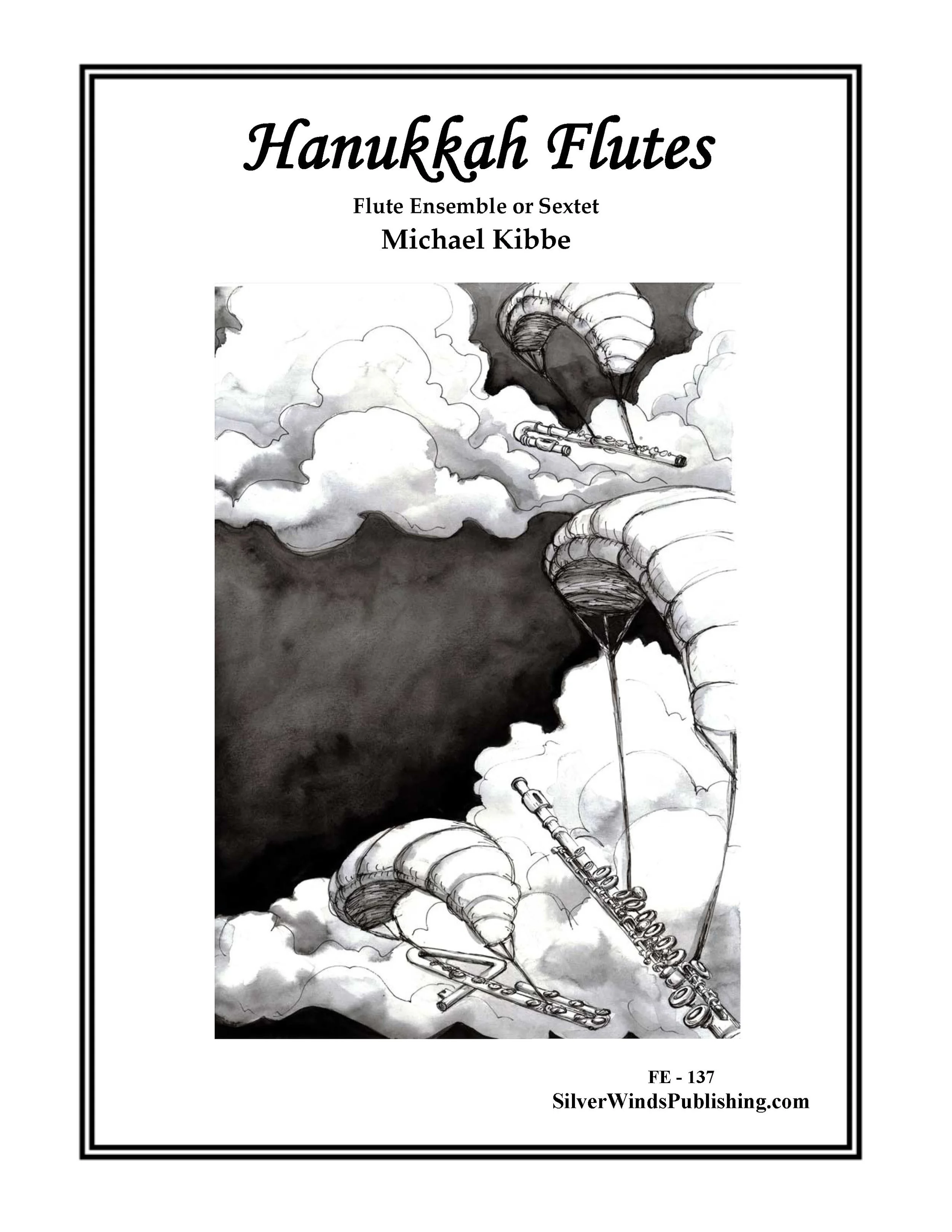
Michael Kibbe, composer, has a total creative output of over 310 concert works, including six string quartets, twenty‐four wind quintets, and a large variety of mixed chamber music for winds, strings, brass, harp, keyboards and percussion. His catalogue includes works for band, orchestra and concerto soloists. Kibbe’s compositions have been performed throughout the United States, Mexico, Europe, and China.
As oboe soloist he has appeared in concertos by Bach, Handel, Haydn, Mozart, Marcello, Vivaldi and Kibbe. In addition to a performing degree on oboe and bassoon, he plays most other standard woodwind instruments, and performed and recorded professionally for over 40 years in the Los Angeles area. He also performed at numerous celebrity events, including the weddings for Barbara Streisand, Charlie Sheen and Brooke Shields.
For 17 years he was oboist and arranger with the Los Angeles based North Wind Quintet, which performed in concerts and on radio broadcasts, presented hundreds of school programs, and toured Mexico three times.
He currently resides in far northern California and plays oboe and English horn in the Eureka Symphony, where he is also the Music Librarian. He is a founding member of Wind Energy, a wind quintet that performs in Humboldt County.
This is a digital version of the piece that you can download as a PDF and print .
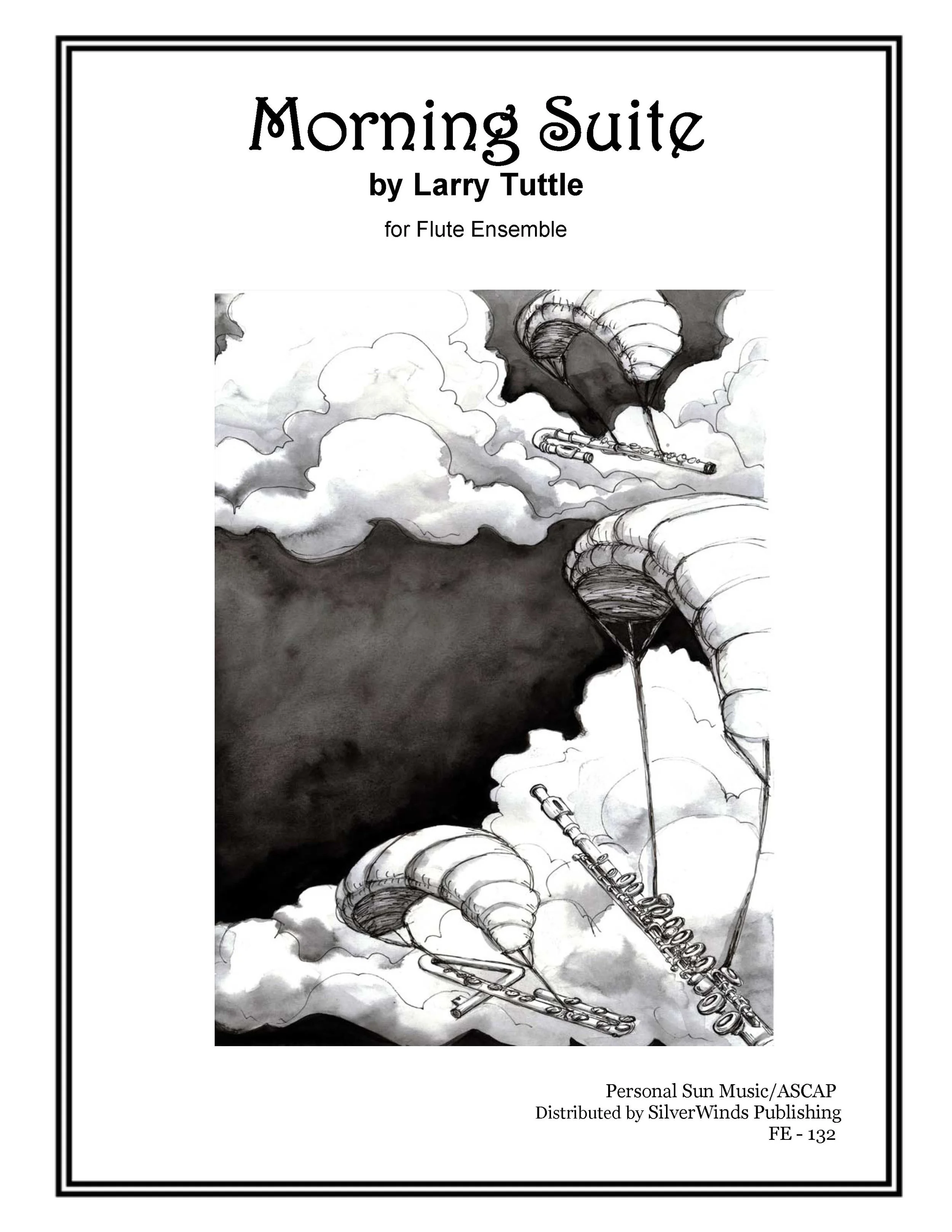
Personal Sun Music/ASCAP
Distributed by SilverWinds Publishing
INSTRUMENTATION
Piccolo
4 C Flutes
Alto Flute
Bass Flute
Contrabass Flute
PROGRAM NOTE
Morning Suite was written on a commission from the Long Island Flute Club in honor of their 40th Anniversary. It’s designed to showcase the best qualities of the flute in all its forms, and to be fun and challenging for the players. The piece has four movements, illustrating four stages of morning. It’s played as one continuous work, without any stopping or separation between movements, to maximize the sense of story and flow.
The first movement, WATERCOLOR DAWN, is soft and pastel-toned, based on a set of chords in four voices. There are “sighing” figures which regularly appear between statements, some lonely melodies in the piccolo, and some gently rhythmic lines.
DAYBREAK (movement two) announces the start of the day with crisp syncopations and a brisk tempo. The two main melodic figures are bird-like in nature, with the first appearing mostly in solo or duet form, and the second played by all of the flutes in unison, sounding like a large flock. Also included are a couple of callbacks to the first movement, moving now at a faster pace. As we near the end of DAYBREAK, the tempo accelerates and the energy ramps up, leading directly into the third movement.
THE MORNING SCRUM is where the group really goes to work. At an aggressive tempo of 160 BPM, there are a lot of challenging passages, with the high and low flutes taking their turns playing busy riffs, rhythms and themes, portraying the manic nature of a typical day here in the 21st- Century. THE MORNING SCRUM ends in an insane gigantic flurry, finally plummeting all the way down to the bottom range of the flute.
ALL THE WORLD UNDER THE SUN, the finale, rises out of the low note with a gentle sweetness built on delicate major harmonies. It features the low and high flutes in dialogue - the piccolo and first flute have a short lyric melody, and the low-register flutes answer with an ascending line, and they alternate as the movement unfolds. Midway through there is another callback to the Watercolor Dawn chords from the opening movement, this time played over a pedal in the low bass, which then leads on to the final coda.
This is a digital version of the piece that you can download as a PDF and print.
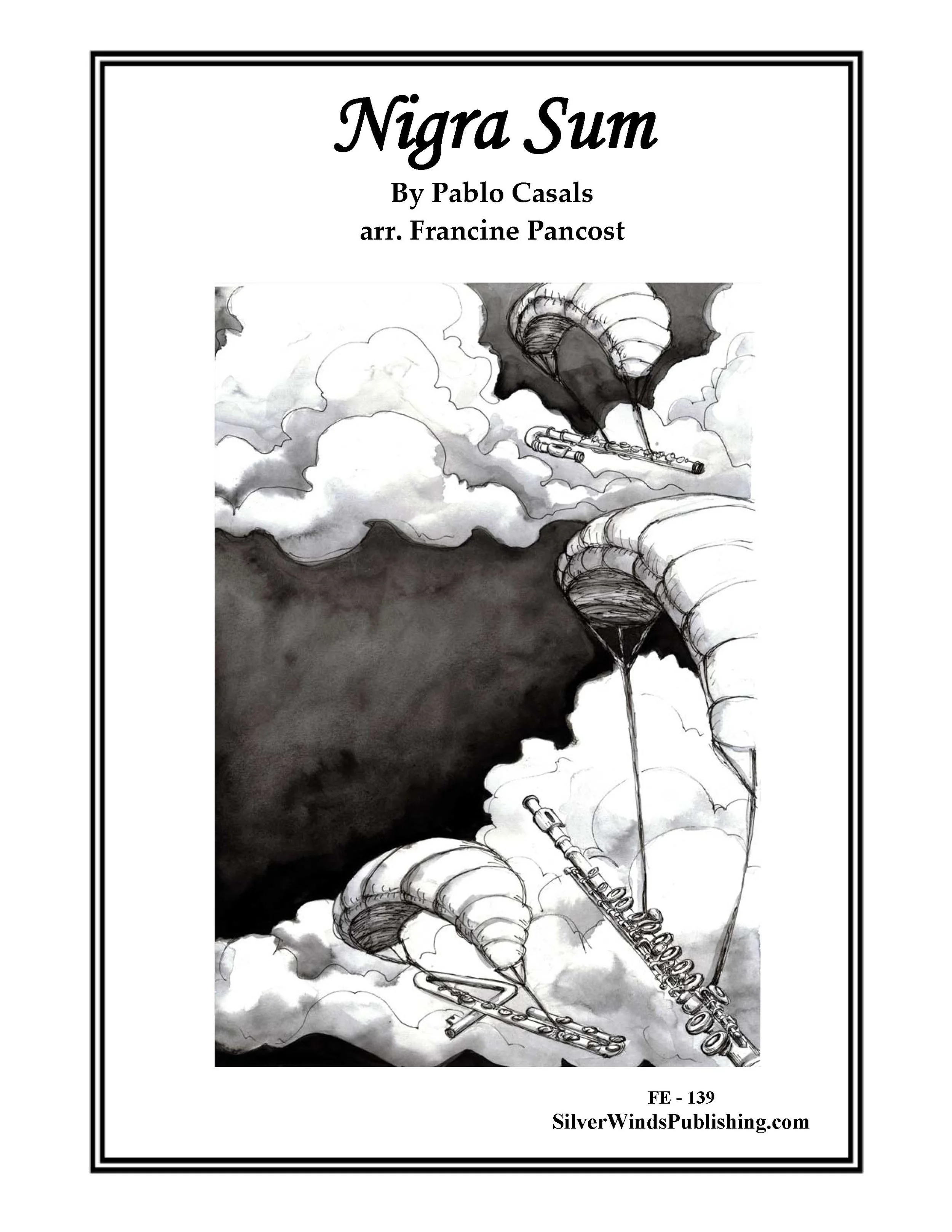
Most people know Pablo Casals as one of history’s greatest cellists. But he was also a conductor, educator, and composer. In 1942, when Casals was 66, Pablo Casals (1876–1973) wrote “Nigra Sum,” one of his best-known choral works and one of the most beautiful choral works ever written. This beautiful choral composition was written for the Choir School at Montserrat, near Barcelona.
Nigra sum sets in a collection of biblical verses. Casals’s work uses verses I:4–5 and II: 10–11 from the Song of Solomon. The Song of Solomon is part of the Jewish, Catholic, and Protestant Bible.
Duration: 5’15”
This is a digital version of the piece that you can download as a PDF and print.
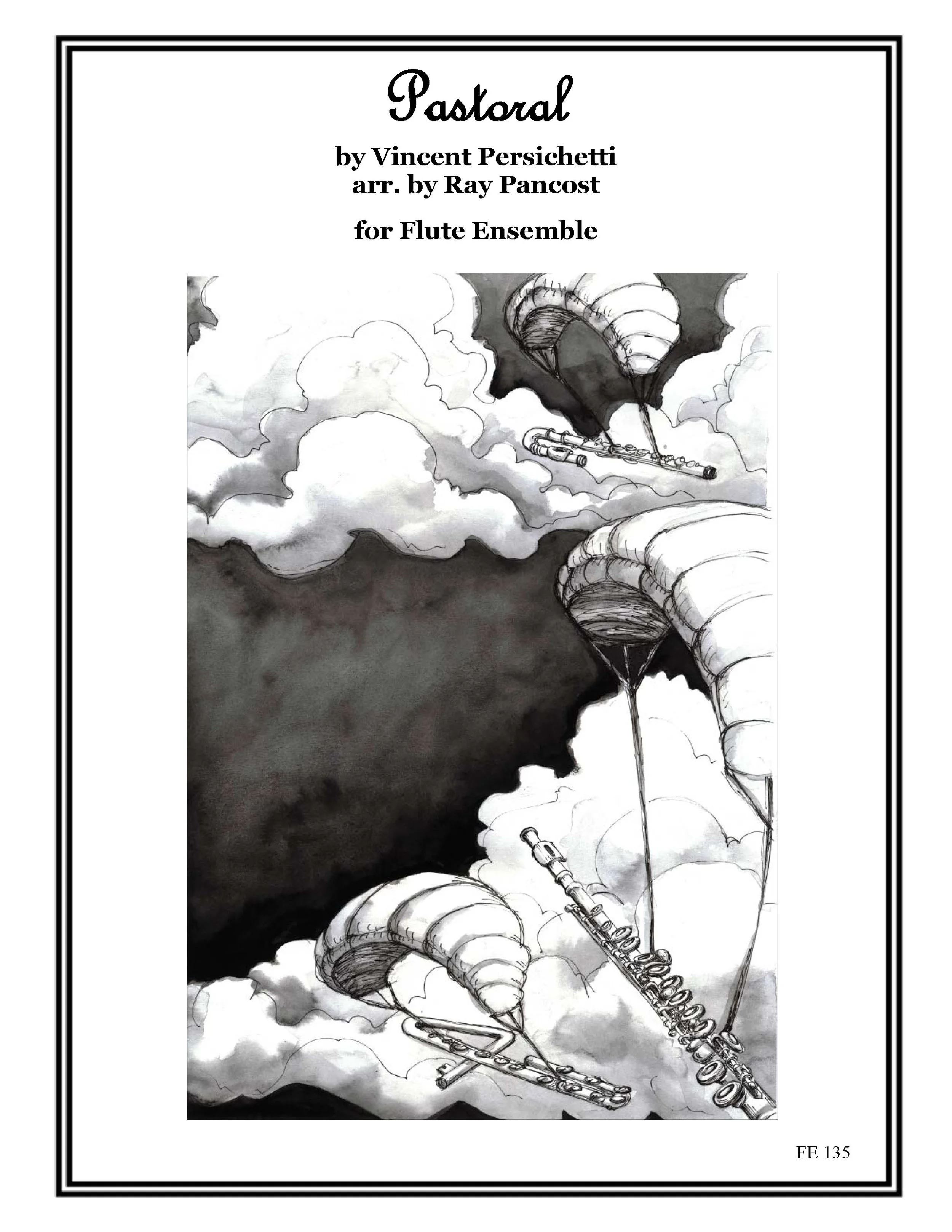
Pastoral by Vincent Persichetti (1915-1987)
Arranged by Dr. Raymond Pancost
Copyright by Permission G. Schirmer Inc.
INSTRUMENTATION:
Flute 1, 2, 3
Alto Flute 1, 2
Bass Flute 1, 2
Contrabass
Duration: 6:05
Program notes:
While deciding on a new piece to arrange I came across one of my favorite quintet pieces which I arranged for woodwind ensemble.
The Pastorale was written in 1943 for the Curtis Woodwind Quintet in Philadelphia.
The lower the flute choir instruments, the softer they become, so I endeavor to balance the parts by selective dynamics and doubling as needed. The tempos given are guide posts which I also use to hear the playback on my computer, thus the tempos are at the speed which I have written the arrangement to my satisfaction.
I hope you enjoy the piece as much as I do.
-Dr. Raymond Pancost
This is a digital version of the piece that you can download as a PDF and print .
Pavane for a Dead Princess by Maurice Ravel (1875–1937)
Arranged by Dr. Raymond Pancost
2026
INSTRUMENTATION:
Flute 1, 2, 3
Alto Flute 1, 2
Bass Flute 1, 2
Contrabass
Duration: 5:55-7:00 depending on tempos taken.
Program notes:
The lower the flute choir instruments, the softer they become, so I endeavor to balance the parts by selective dynamics and doubling as needed. The tempos can be adjusted to your group.
I hope you enjoy the piece as much as I do.
-Dr. Raymond Pancost
This is a digital version of the piece that you can download as a PDF and print.
The Pipes Of Pan, opus 233, for Flute Orchestra
Michael Kibbe
A single flute announces the piece with a brief cadenza that acts as the basis for much of the following musical development.
When composing this piece I tried to keep in mind an image of multiple flutists and wood nymphs (worshipers of the god Pan?) meeting in the forest for both thoughtful communion and festive dancing.
And so “The Pipes Of Pan” alternates between slow contemplative passages and more rapid, dance-like sections. Part-way into the allegro (letter E) the low flutes create a chromatic underpinning for the group; like the unsettled whistling of a stormy wind.
As in most of my music, I try to ensure that each player has a sense of “purpose” for being there. It is not only the principle flute that has solo passages; important lines exist also for the secondary flutes, the piccolo and the low flutes.
This is a digital version of the piece that you can download as a PDF and print.
Ancient Christmas Carols
Christmas carols officially emerged in the 14th century, though their roots stretch back to ancient, pre-Christian midwinter festivals. Franciscan friars, inspired by Saint Francis of Assisi, created the earliest Christian carols—originally sung as group circle dances. This collection of carols opens with the well-known Basque folk carol Gabriel’s Message which is based on the 13th century Latin Advent carol Angelus Ad Virginem. The second carol, Normandy Carol, also referred to as the Normandy Tune (traditional French folk melody), dates to the 13th century and originates from Basque country. The tune is often used as an alternate melody to the traditional Christmas hymn Away in the Manger. A “Basque” is a member of an indigenous ethnic group living in the western Pyrenees region of Spain and France.” (Merriam-Webster) The third carol, Branle de l’Official, also known as Ding Dong! Merrily on High (20th century lyrics), was composed in the 16th century by French cleric Jehan Tabourot. Published in 1589 in his dance manual Orchésographie, Tabourot used the pen name Thoinot Arbeau. Seeing as he was a Catholic priest and canon, publishing a manual that focused on social dancing and using his given name would have been frowned upon–he had a reputation to protect!
The first two carols showcase the various voices of the flute choir with prominent solo lines and drones. For obvious reasons, the lower octave of the piccolo is seldom heard in ensemble music, including flute choir arrangements. But as a solo voice in combination with alto, bass or contrabass flute, it allows us to hear tone colors seldom used. With the increasing interest in and popularity of lower- voiced flutes, a wider palette of tone color is available, which is necessary when arranging simple melodies such as these. The third carol has dramatic, subito dynamics and specific articulation markings that should be strictly adhered to, avoiding tedium. It includes verses with soloists, a verse with piccolo and C flutes, and a verse featuring alto, bass and contrabass flutes. The articulations are purposefully not always the same between parts in any given section.
I have always been an advocate of the “no vibrato rule” in the flute choir setting. Using vibrato on solos is acceptable if it works within the context and style of the music. All three carols were composed well before flutists started to use vibrato. With that in mind, it is highly recommended that flutists avoid using any vibrato, especially on drones, accompanying material or chords that support melodic lines.
This is a digital version of the piece that you can download as a PDF and print.